Product Features
I. Equipment Functions
Process Compatibility
The laser welding process is employed, enabling precision control of the penetration depth within ±0.1 mm; this addresses the issues of cracking and porosity that occur with traditional welding methods.
Manual Loading and Unloading
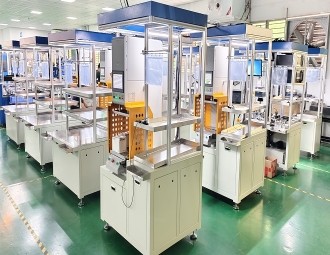
The equipment allows for manual loading and unloading of workpieces, making it suitable for production scenarios involving small batch sizes and multiple product variants, while offering both flexibility and cost efficiency.
Intelligent Control
Real-time monitoring and early warning: Sensors monitor current, voltage, and wire feeding speed; in case of abnormalities, the equipment shuts down automatically and alerts are sent.
II. Customization Capabilities and Service Support
Customized Design for Specific Needs
Special fixtures are designed based on the shape and dimensions of the customer’s workpieces, ensuring accurate positioning and stable welding results.
Process Parameter Database
A database storing information on materials, thicknesses, and welding parameters is available, allowing for quick access and reducing the time required for debugging.
Delivery and After-Sales Support
Rapid Delivery: After pre-assembling the equipment, it undergoes 72 hours of continuous operation testing under conditions similar to those in the customer’s facility; the installation and debugging process takes no more than 10 days.
Warranty and Response Time
The core components (laser, optical system) come with a 2-year warranty, while the entire equipment is covered by a 1-year warranty. On-site support is provided within 48 hours in China, with remote technical assistance available within 2 hours.
III. Customer Benefits
Cost Reduction and Efficiency Improvement
By replacing manual welding, reliance on welders is reduced (saving 40%-60% on labor costs), productivity increases by 1-2 times, and the payback period for the investment is reduced to 12-18 months. Welding consistency exceeds 99%, with the rework rate dropping below 1%, thus minimizing quality losses and customer complaints.
Technological Forwardness
The equipment includes interfaces for process upgrades (such as adding new welding methods or detection modules), enabling further technological advancements and extending the equipment’s lifespan to 8-10 years.