
The necessity of transitioning from traditional manufacturing industries to automation industries
The "Industry 4.0" strategy was first officially launched by Germany at the Hanover Industrial Fair in 2013, with the aim of enhancing the competitiveness of German industry and seizing the initiative in the new round of industrial revolution.
The so-called Industry 4.0 is a division based on different stages of industrial development. According to the current consensus, Industry 1.0 is the era of steam engines, Industry 2.0 is the era of electrification, Industry 3.0 is the era of informatization, and Industry 4.0 is the era of using information technology to promote industrial transformation, that is, the era of intelligence.
The so-called Industry 4.0 in Germany refers to the use of Cyber Physical Systems (CPS) to digitize and intelligentize supply, manufacturing, and sales information in production, ultimately achieving fast, effective, and personalized product supply. In May 2015, the State Council officially issued the "Made in China 2025" plan to comprehensively promote the implementation of the strategy of building a strong manufacturing country. The cooperation and connection between "Made in China 2025" and Germany's "Industry 4.0" have a long history. Industry 4.0 has entered a new era of cooperation between China and Germany. In the "Action Plan for China Germany Cooperation" signed by both sides, there are four articles related to Industry 4.0 cooperation. The first article clearly states that the digitization of industrial production is of great significance to the future economic development of China and Germany, known as "Industry 4.0". Both sides believe that the two governments should provide policy support for businesses to participate in this process
From Premier Li Keqiang's emphasis on the cooperation of Industry 4.0 in the Sino German Cooperation Platform for Action in 2014 to Ma Yun's statement at the World Zhejiang Business Summit Forum in 2017, the manufacturing industry will suffer a huge impact, no less than the traditional retail industry facing the impact of the Internet. New manufacturing industries are coming, and China has not even automated its umbrella manufacturing. It is not difficult to see that the transformation of the manufacturing industry from traditional manufacturing to intelligent manufacturing is the general trend and an imperative trend.
For large-scale processing and production orders, adopting non-standard customization is more cost-effective and efficient compared to traditional processing methods,
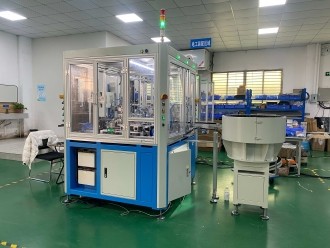
Dongguan Helide Automation Equipment Co., Ltd. specializes in the design, research and development, and assembly of non-standard automation equipment. Currently, we have many years of experience in the research and development of automation assembly equipment in the industries of building hardware, electronic assembly, instrument assembly, and automotive parts. Our comprehensive non-standard customized design meets your customization needs, and our after-sales service is perfect, which is worthy of your trust. www.dghelide.com.cn
